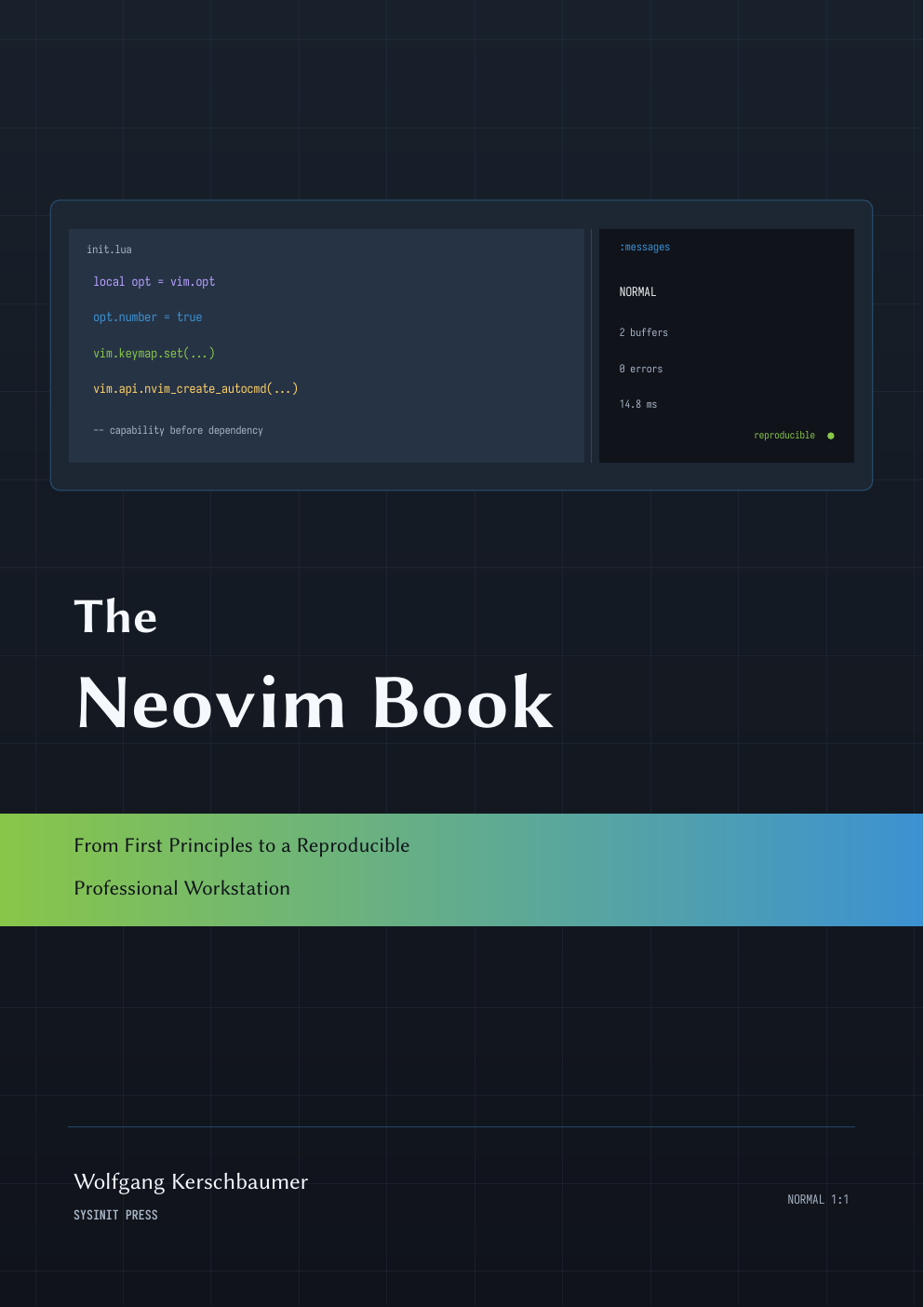
The Neovim Book
From First Principles to a Reproducible Professional Workstation.
Coming soon
Neovim is a small runtime that you can inspect and program. The book starts with a clean nvim process and explains native editing, Lua configuration, the API, events, Tree-sitter, and the built-in LSP client before adding plugins. Each plugin fills a specific gap, with its responsibilities and fallback documented. LazyVim comes last, once its parts are familiar.
Status: the first-edition manuscript is content complete (31 chapters, 5 appendices, about 95,000 words). The local PDF and EPUB have passed their release checks; external publication is not configured yet.
First edition ships DRM-free as PDF and EPUB, with free updates.
Reader poll Readers pick which Sysinit Press title we finish next. The Neovim Book is on the ballot.
Vote for this bookBuild a Neovim setup you can explain and reproduce.
The book begins with native editing and Lua, then adds language tooling and plugins when a concrete need appears. It closes by unpacking LazyVim and covering performance, security, troubleshooting, and reproducible setups. Open a part to see its chapters.
What this book assumes, and how to read it
Part 1 Lineage and Foundations 3 chapters
- 1 From vi to Neovim
- 2 Neovim and Vim
- 3 The Editor as a State Machine
Part 2 Native Editing Craft 6 chapters
- 4 A Clean-room Configuration
- 5 Options, Mappings, Commands, and Autocommands
- 6 Editing as a Composable Language
- 7 Registers, Macros, and Repeatable Work
- 8 Buffers, Windows, Tab Pages, and Lists
- 9 Files, Projects, Sessions, and Native Navigation
Part 3 Lua and the Neovim Runtime 5 chapters
- 10 Lua Configuration as Software
- 11 The API Object Model
- 12 Events, Scheduling, Jobs, and Channels
- 13 Terminal, Headless, Remote, and UI Clients
- 14 Authoring and Testing a Small Plugin
Part 4 Language Tooling Without an IDE Shell 4 chapters
- 15 Trees and Syntax
- 16 The Built-in LSP Client
- 17 Diagnostics, Completion, Snippets, Formatting, and Linting
- 18 Project Toolchains
Part 5 Plugins by Demonstrated Need 7 chapters
- 19 The Plugin System from First Principles
- 20 Dependencies and lazy.nvim
- 21 Interface and Feedback Plugins
- 22 Navigation, Search, Git, and Editing Plugins
- 23 Language-intelligence Plugins
- 24 Domain Workflows
- 25 AI-assisted Editing
Part 6 Turn-key Frameworks 2 chapters
- 26 LazyVim Anatomy
- 27 Operating and Customizing LazyVim
Part 7 Production Practice 4 chapters
- 28 Performance and Startup Engineering
- 29 Security, Trust, and Reproducibility
- 30 Troubleshooting and Recovery
- 31 Capstone: A Minimal Professional Workstation
Part 8 Appendices 5 appendices
- A Migrating Vim Configuration
- B Command, API, Event, and Runtime-path Atlas
- C Pinned Plugin Catalog
- D Sources, Reproducibility, and Verification
- E Glossary and Generated Subject Index
For professionals who already know editing basics.
You can enter and leave Insert mode, move, search, save, and survive :help. The book assumes no Lua expertise, no plugin-manager familiarity, and no knowledge of Neovim internals.
- IT professionals who use one editor across many languages and repositories.
- Engineers who want language tooling without an IDE shell: Tree-sitter, the built-in LSP client, diagnostics, and formatting.
- Operators who need a configuration that another person can reproduce and repair.
Coming soon.
Join the shared Sysinit Press book list for release news, sample chapters, and updates to published editions. The first edition will include DRM-free PDF and EPUB files with free updates.
The signup uses double opt-in. Every message includes an unsubscribe link.